
The Unmet Promise of AI – Neural Impact
March 4, 2026
The Hidden Neuroscience Behind Every AI Buying Decision
July 27, 2026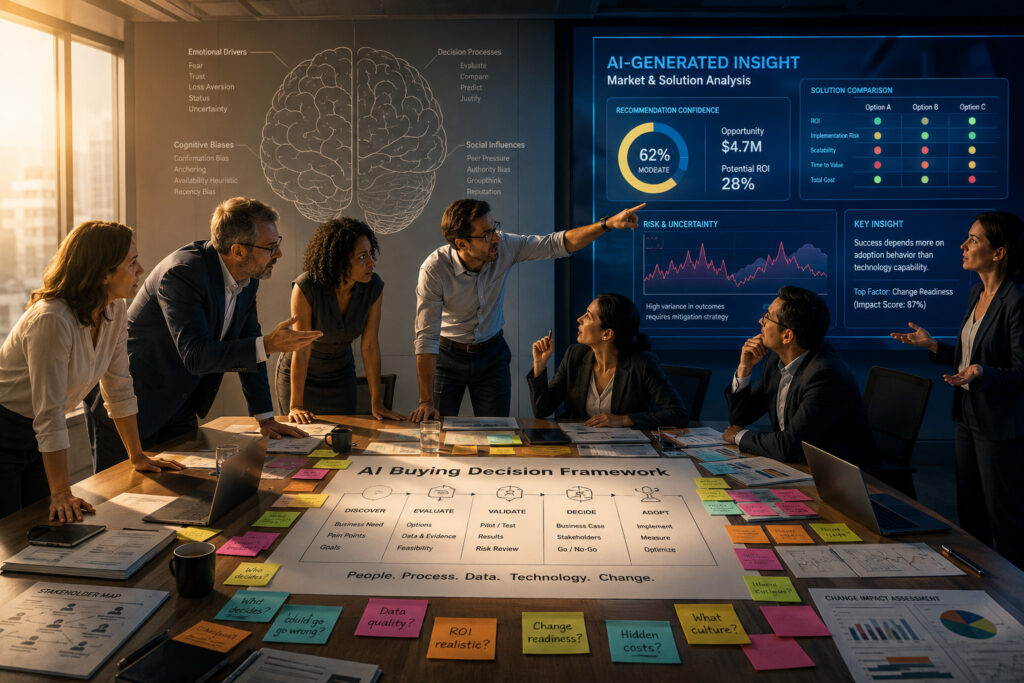
The Hidden Neuroscience Behind Every AI Buying Decision
Technology buyers like to believe they make rational decisions. Research says otherwise. It’s not the new AI “agent technology” that will get buyers to commit, buy and implement it, but how they feel about it. (Stop talking about technology!!!)
Most buyers will tell you they buy new software based on features, cost, ROI, security, and business cases. They don’t. The same applies for AI solutions. Of course, those things matter, but only after the brain has already made an emotional judgment FIRST.
Neuroscience has shown that emotion isn’t the opposite of logic; it’s what enables decision making in the first place. Patients with damage to the emotional centers of their brain can often analyze information perfectly yet struggle to make even simple decisions. We feel first, then justify with facts. It’s called confirmation bias. (If you’ve ever interviewed someone, you know you make an emotional decision in the first minute and then spend the next 30 minutes looking for evidence to support your initial emotional judgement. The judgement isn’t logical based on their resume and years of experience (features) it’s based on your brain scanning their body language, posture, handshake, confidence, tone of voice, clothes, speaking speed and more).
This is especially true when buying AI. Unlike purchasing traditional software, AI introduces fear and uncertainty. It changes jobs, workflows and even how people define their own value within an organization. The emotional stakes are significantly higher.
In our work with Microsoft partners and technology companies around the world, we’ve found that the most successful AI sales conversations address several core emotional drivers:
Emotional Framework That Drives AI Buying Decisions
- Trust – Can I believe you, the vendor? Will this actually work? Do you know what you are doing? (and prove it!)
- Fear – What happens if we don’t leverage AI? What happens if we do? Is it secure? What if it doesn’t go well? Will people resist? Will jobs be lost?
- Risk Reduction – Help me avoid making a career limiting mistake. What can go wrong? How will our team react? What if it gives us inaccurate information? Is it secure?
- Control – I want confidence that this change won’t spiral beyond my ability to manage it. Who has access? Is the information confidential?
- Confidence – Make me feel capable of leading this transformation. This is new. I am hesitating due to lack of confidence. I have no idea what I am doing!
- Relief – Are there any guardrails? How can you make sure it all goes well? What will you do if it doesn’t? Remove complexity, uncertainty, fear and pressure.
- Curiosity – Show me what’s possible that I haven’t considered. What are my peers and competitors doing? Get my interest.
- Hope/Desire/Greed – Help me believe our company future can be better than our present. Show me a work experience I would love to have. Paint a picture of this new “after” experience I want. (contrasting before and after is powerful)
- Aspiration – Position AI as a way to become the organization we want to be.
- Status – Great leaders want to be seen as innovators, not followers. How will this make me look good amongst my peers and industry?
- Belonging – Not too long ago it was dangerous to get kicked out of the tribe (starvation/death) or to not fit in (witches burned at the stake). No executive wants to fall behind while competitors move ahead (getting fired =modern day “death”).
- Achievement – People want measurable wins they can celebrate. What are the KPI’s you can help them move that they care about? Revenue? New customers?
- Certainty – The brain constantly searches for predictability in an uncertain world. (and we know there is lots of that in our world today!)
- Simplicity – Every unnecessary step increases cognitive load and decision fatigue. Tech providers over build, over complicate and add way too much functionality into new solutions. Build minimum lovable AI agents and solutions. Do one thing well and make them love it and not want to live without it. Less is more. (have you looked at the menus in word or excel lately? OMG my head aches just looking at them).
- Recognition – Buyers want their success to be noticed by peers, executives, and their teams. Invite them to customer panels at industry events, feature them in case studies, help them be the hero in their organization. Help them get rewarded for taking a risk and implementing AI.
We are fascinated and drawn to AI, but we are simultaneously terrified of it. The human brain is constantly balancing “is this safe?” and “is this rewarding?”.
Every presentation, website, demo, pricing proposal, and sales conversation either increases perceived threat or increases anticipated reward.
The best technology companies don’t simply explain what their AI solutions do. They reduce fear, build trust, create certainty, inspire hope, and give buyers confidence that they’re making the right decision.
That’s why two companies with similar technology often achieve dramatically different sales results. One sells features. The other considers how people feel and brings a narrative to the sales cycle that speaks to their fears and desires. Emotions trigger buying searches and decisions. No sales VP gets up in the morning and says, “today is the day I’m going to find a new AI sales solution”. When they miss their forecast (and get chastised) this emotion sends them on a search to find a new CRM solution. Stimulus and response.
This emotional framework works particularly well for Microsoft partners and AI companies because it shifts the conversation from explaining AI to reducing the emotional barriers to AI adoption—which is where most opportunities are actually won or lost.
Want help with a live technology sales opportunity you really want to close?
Have a deal that’s stalled or ended in a no decision? Working on your AI strategy?
We can help!
engage@neuralimpact.ca www.neuralimpact.ca